
Changes Worth Reporting Now
- Appliance warning signs include new leaks, repeated cycle stops, unusual noises, and changes in heating or cooling.
- Stop using an appliance that smells burned, sparks, or has damaged cooking glass.
- Call with the symptom you noticed; no inspection, model search, or test cycle is required first.
Common Symptoms and Safe Next Steps
Refrigerator Changes Call for a Cooling Check
| Sign | Likely cause | What to do |
|---|---|---|
| Both compartments feel warm | Possible control or cooling fault | Call and limit door openings. |
| Fresh food warms but freezer stays cold | Possible airflow or fan fault | Keep doors shut and call. |
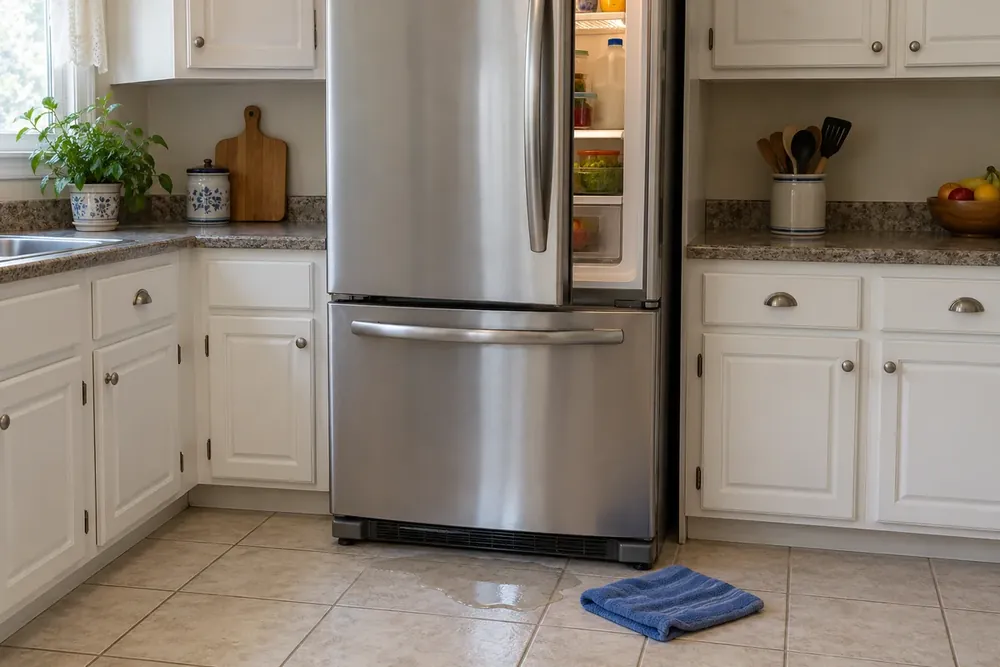
| Water collects underneath | Possible drain or water-system leak | Call about the puddle. |
| New repeated clicking | Possible starting component fault | Call about the clicking. |
Cooling changes need diagnosis because several faults can produce the same symptom.
- A light turning on does not establish that cooling works properly.
- Describe whether one compartment or both have become warmer than usual.
- Mention any recent changes without moving the refrigerator away from cabinetry.
Whirlpool lists airflow, seals, and internal failures among reasons for a refrigerator not cooling. Call now; none of these checks or observations is needed first.
Freezer and Ice Maker Changes Affect Different Functions
| Sign | Likely cause | What to do |
|---|---|---|
| Frozen food softens | Possible cooling fault | Limit door openings and call. |
| Heavy frost returns | Possible seal or defrost fault | Report the frost during your call. |
| Ice production stops | Possible fill or ice-making fault | Call about the missing ice. |
| Water leaks near ice storage | Possible valve or fill-system leak | Stop using the ice maker and call. |
Report lost cooling separately from a change in ice production.
- An ice maker can stop working while the freezer remains cold.
- Tell your technician whether the ice stopped suddenly or gradually declined.
- Frequent door openings make it harder to preserve the remaining cold.
FoodSafety.gov recommends keeping refrigerator and freezer doors shut during outages. Limit door openings while calling; assess food safety separately.
Washer Leaks and Stops Need a Clear Description
| Sign | Likely cause | What to do |
|---|---|---|
| Water appears during filling | Possible hose or inlet valve leak | Stop the cycle at its controls and call. |
| Water appears during draining | Possible pump or drain-path leak | Keep clear of wet areas and call. |
| Drum will not spin | Possible lid lock or drive fault | Call about the stopped function. |
| Heavy banging begins | Possible load or suspension issue | Switch the washer off at its controls. |
Call about a washer leak without running another load to locate it.
- Describe whether the water appeared near the front, back, or underneath.
- Read the exact displayed code during the call without interpreting it.
- Keep away from water around electrical equipment rather than reaching through it.
For anyone deciding who to call for a leaking washing machine, an appliance repair technician assesses faults within the machine. Whirlpool identifies pump, drain-pipe, and tub-seal problems as possible leak sources; water on the floor alone does not identify which one failed.
Dryer Heat and Noise Changes Need Attention
| Sign | Likely cause | What to do |
|---|---|---|
| Clothes stay damp | Possible airflow or heating fault | Call about the longer cycles. |
| Drum stops turning | Possible belt or drive fault | Stop using the dryer and call. |
| New squealing develops | Possible roller or bearing wear | Stop use and call. |
| Burning odor appears | Possible overheating or lint hazard | Stop use; leave and call 911 if fire is suspected. |
A dryer that smells burned should stay out of use.
- Tell your technician whether the drum moves and whether heat has changed.
- Repeating a cycle can conceal a developing fault while delaying its assessment.
- A clean lint screen does not rule out restricted airflow elsewhere.
The CPSC recommends cleaning lint filters before or after each use. Lint-screen care does not replace professional fault diagnosis.
Dishwasher Symptoms Include Water Left Behind
| Sign | Likely cause | What to do |
|---|---|---|
| Water remains after a cycle | Possible drain restriction or pump fault | Call about the standing water. |
| Dishes stay dirty | Possible circulation or spray fault | Call about poor washing. |
| Water escapes at the door | Possible seal or filling problem | Stop the cycle at its controls and call. |
| Cycle repeatedly stops | Possible latch, control, or sensor fault | Report the stopping point and displayed code. |
A dishwasher symptom helps direct the inspection but does not identify a replacement part.
- Describe whether the dishwasher fills, washes, drains, or stops partway through.
- Mention whether the problem affects every load or started with one.
- Avoid pulling the appliance out to investigate a hidden leak yourself.
A stopped cycle and a failed drain are different observations, although both can leave water inside. Describe the last attempt without restarting.
Oven and Range Symptoms Need Safety First
| Sign | Likely cause | What to do |
|---|---|---|
| Oven does not heat | Possible element, igniter, or control fault | Switch it off at its controls and call. |
| Cooking becomes uneven | Possible sensor or heating fault | Call about the change in results. |
| Cooktop glass cracks | Damaged surface assembly | Stop using the range and call. |
| Gas odor appears | Possible gas leak | Leave without touching switches; call the gas utility or 911 outside. |
A gas smell calls for leaving the area and reporting it from outside.
- Keep cooking equipment off when heating becomes uncontrolled or glass is damaged.
- Describe the affected oven function rather than testing several settings again.
- Report a gas odor only after reaching a safe place outside.
LG&E and KU advise leaving the area of suspected gas leaks, avoiding switches, and calling from safety. Call about repair after addressing the danger; GE Appliances advises stopping range use if cooktop glass cracks.
Microwave Changes Need the Case Left Closed
| Sign | Likely cause | What to do |
|---|---|---|
| Runs without heating | Possible heating component fault | Stop use and call about the change. |
| Sparks appear inside | Possible cavity, cookware, or component issue | Switch off at the controls and call. |
| Door will not close firmly | Possible hinge or latch damage | Stop using the microwave and call. |
| Turntable stops rotating | Possible drive or motor fault | Call about the turntable. |
Microwave diagnosis belongs with a technician even when the appliance is unplugged.
- Internal components can retain a dangerous charge after power is removed.
- A damaged door needs assessment even if heating still seems normal.
- Share the visible display code without taking covers or panels off.
GE Appliances warns that an internal capacitor can remain charged after unplugging. Call about symptoms; one of our local appliance repair partners handles diagnosis.